
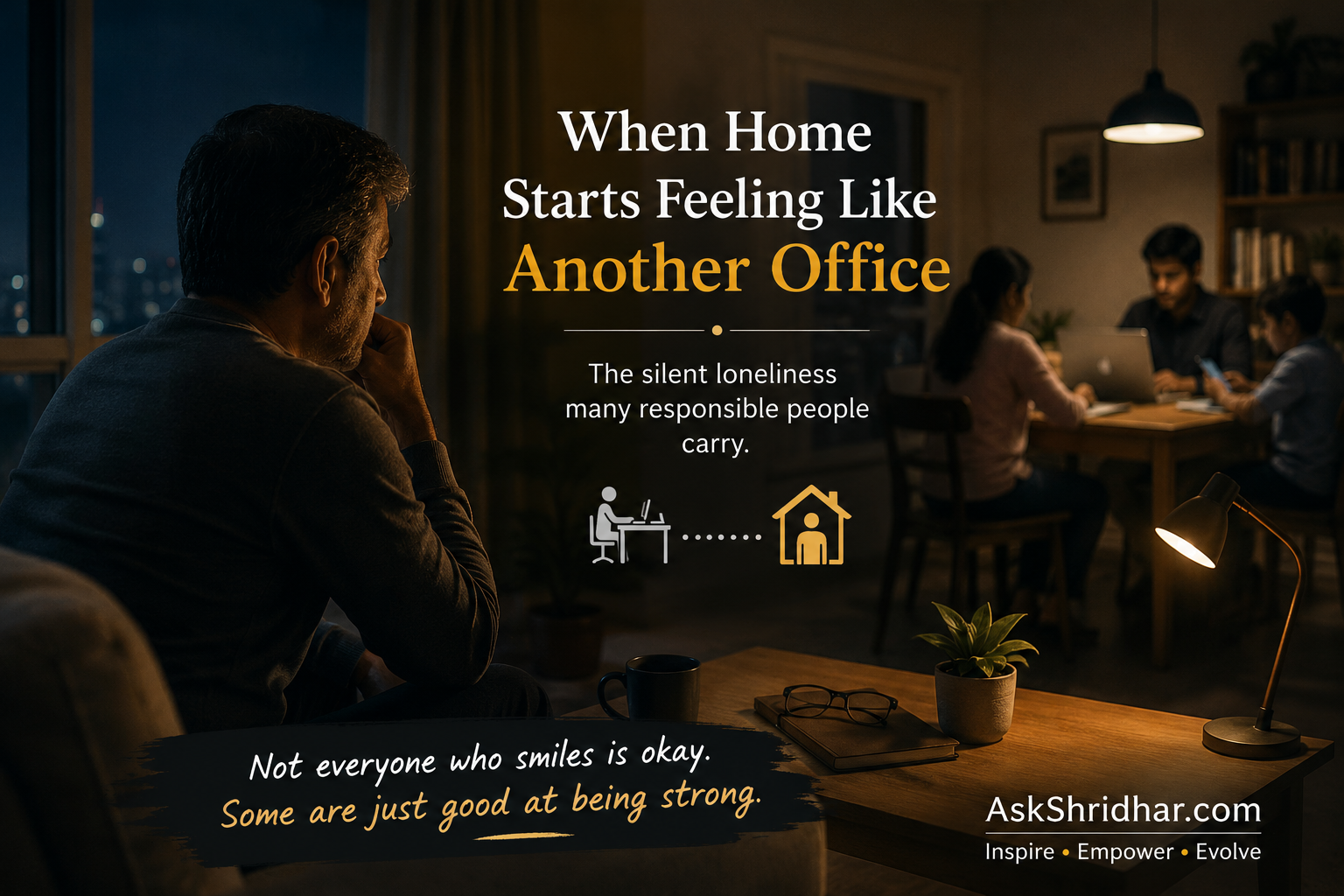
The silent loneliness many responsible people carry.
There is a kind of loneliness that does not come from being physically alone. It comes from sitting in a house full of people and still feeling emotionally disconnected.
Many responsible people — especially those who spend decades working, providing, solving problems, guiding families, and carrying responsibilities — slowly reach a stage where life begins to feel strangely mechanical. Conversations become functional. Interactions become transactional. Appreciation becomes rare. Presence becomes assumed.
And one day, a painful thought quietly appears:
“I feel like I am just moving from one office to another office.”
At work, people interact to get tasks done. At home, people interact to manage routines. Somewhere in between, emotional warmth slowly disappears.
The Loneliness Nobody Talks About
This loneliness is difficult to explain because outwardly life may look completely normal. The family is there. The responsibilities are running. Daily routines continue. But internally, something changes.
A person who once felt emotionally connected begins feeling:
- unheard,
- unimportant,
- emotionally invisible,
- or valued only for usefulness.
And because mature people are expected to remain “strong,” they rarely speak openly about it. So they continue functioning while carrying silent emotional exhaustion.
Why Does This Happen?
Modern life has trained people to optimize efficiency, not emotional connection. Families discuss bills, schedules, investments, careers, logistics, social obligations. But fewer people discuss fear, loneliness, emotional fatigue, appreciation, affection, or vulnerability.
Over time, relationships can slowly become operational instead of emotional. Not because love completely disappears — but because expression disappears.
The Burden of Being “The Strong One”
Ironically, the people who appear strongest often become the loneliest. The dependable person in the family is usually assumed to be emotionally self-sufficient:
- “He will manage.”
- “He is practical.”
- “He doesn’t need support.”
- “He is mentally strong.”
But strength without emotional connection eventually becomes emotional isolation. Even highly capable, intelligent, disciplined people can quietly suffer when they stop feeling emotionally understood.
The Most Dangerous Part: Silent Emotional Drift
The problem is not always conflict. Sometimes the bigger danger is emotional distance growing so gradually that nobody notices it. There are no dramatic fights. No major incidents. Just a slow reduction in warmth.
People start living beside each other instead of emotionally with each other.
And nights become heavy. Because during the day, work and routines keep the mind occupied. But at night, silence amplifies emotional emptiness.
What Can Help?
Not every situation can be repaired quickly. Not every family suddenly changes. But emotional survival matters. A few things can genuinely help:
- reconnecting with personal passions,
- building emotional spaces outside household dynamics,
- reconnecting with old friends,
- learning something new,
- music, walking, spirituality,
- meaningful conversations,
- mentoring others,
- or simply allowing oneself to feel without guilt.
Sometimes healing begins not when life becomes perfect — but when a person stops measuring their entire worth through emotional responses from others.
If You Relate To This
Please know this: feeling emotionally lonely does not mean your life has no value. And being misunderstood does not erase your importance. Many people silently carry this same emotional burden while appearing completely normal from outside.
Perhaps the world needs to talk more honestly about emotional loneliness inside modern families. Because sometimes the people who smile, provide, advise, and remain responsible for everyone else… are the very people silently waiting for warmth themselves.
Not everyone who smiles is okay. Some are just good at being strong.
Written for those who continue carrying responsibilities quietly while searching for emotional connection in a fast, functional world. — AskShridhar.com